Choose an overcoat while wearing the layers you expect to put beneath it. A coat that closes over a T-shirt can behave differently over a jacket or sweater. Start with the actual combination, then judge movement, coverage and daily practicality before comparing decorative details.
Name the coat’s main job, bring the relevant layers to the fitting, and fasten it normally. Reach, sit and walk without forcing the closure. Compare lengths with your longest intended jacket, check pockets and cuffs, and read the material and care instructions. A size-up rule cannot replace trying the cut.
Name the job before choosing the coat
Write down where you will wear it: a short walk to an office, regular public transport, evening events or a longer outdoor routine. Note whether a suit jacket needs to fit underneath and where the coat will go indoors. These details make a fitting more useful than a generic search for the most versatile style.
A tailored overcoat and technical weather clothing answer different needs. Check the actual product specification for insulation and weather resistance; wool content or a heavy appearance does not establish waterproofing. If your main problem is sustained rain, assess appropriate rain protection rather than expecting every formal-looking coat to provide it.
Suitsupply’s illustrated overcoat guide compares single-breasted, double-breasted and other constructions. Use those families to describe what you like. The label does not settle the amount of room, the usable length or the suitability for your conditions.
Bring the heaviest realistic combination
Try the coat over what you genuinely wear together. For a work coat, that may be your shirt and suit jacket. For a casual coat, it may be a particular sweater. Avoid testing an imaginary pile of layers simply because you might wear it once. You want enough space for your routine without making the everyday combination awkward.
Put on the inner garments properly first. Smooth the jacket sleeves and settle the shoulders before adding the coat. Otherwise a trapped cuff or bunched sweater can look like a coat-fitting problem. The layering guide helps plan the combination, while this fitting checks the actual outer garment.
Some makers build room into outerwear. Proper Cloth’s Bowery coat information, for example, describes its layering intent and provides a model-specific size guide. Follow the relevant chart; do not carry one maker’s number or sizing instruction across every coat you try.
Check construction, closure and movement
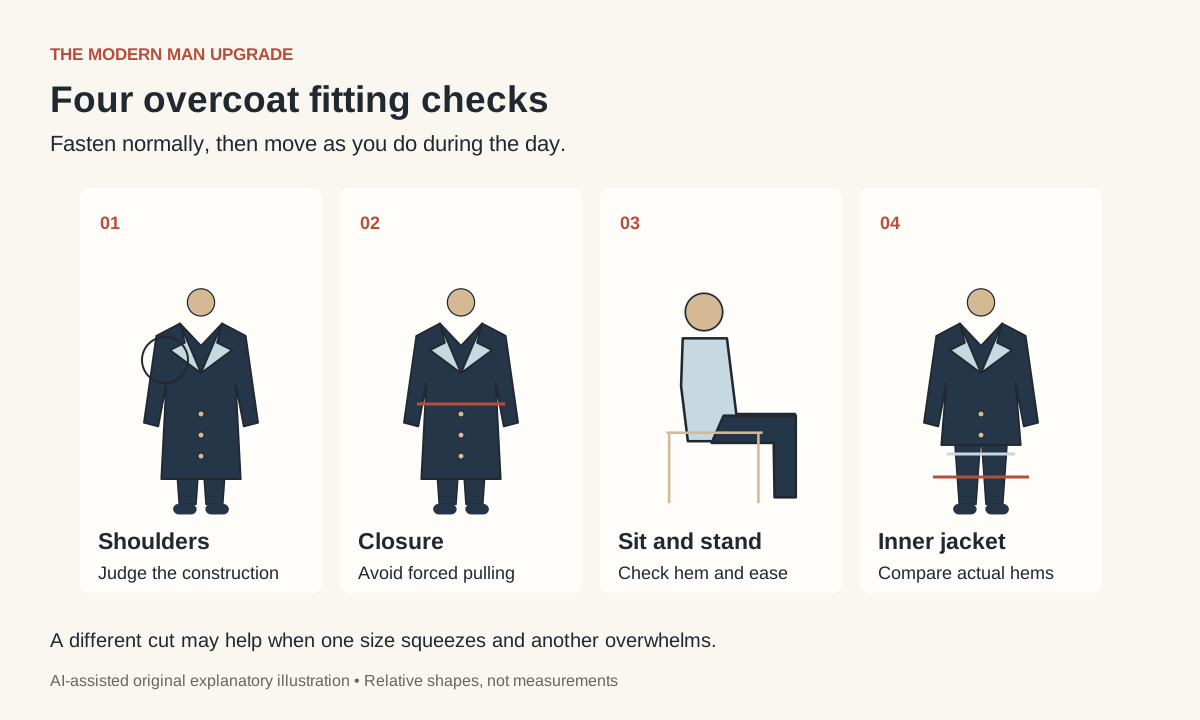
- Settle the collar and shoulders. Look for uncomfortable pressure, folds caused by trapped clothing or an unwanted gap.
- Fasten the coat in its intended manner. Check whether the front pulls or the layers underneath are compressed.
- Reach forward as you would for a door or bag. Notice the upper back and sleeves.
- Sit briefly and stand again. Check the closure, hem and ease of rearranging the coat.
- Put your hands in the pockets and remove them. Confirm that the position and opening are practical.
Assess the design rather than imposing one seam position on every coat. A set-in sleeve and a raglan construction distribute their seams differently. Likewise, a deliberately relaxed coat should be judged as that design, not as a failed fitted jacket. Pain, an unusable closure and restricted everyday movement are reasons to compare another cut.
If one size closes comfortably but leaves sleeves or length unsuitable, ask what an alteration can realistically change. Shoulder construction, lining and pocket placement can limit the options. A tailor’s assessment of that garment is more useful than assuming any expensive coat can be rebuilt.
Compare coverage in your actual routine
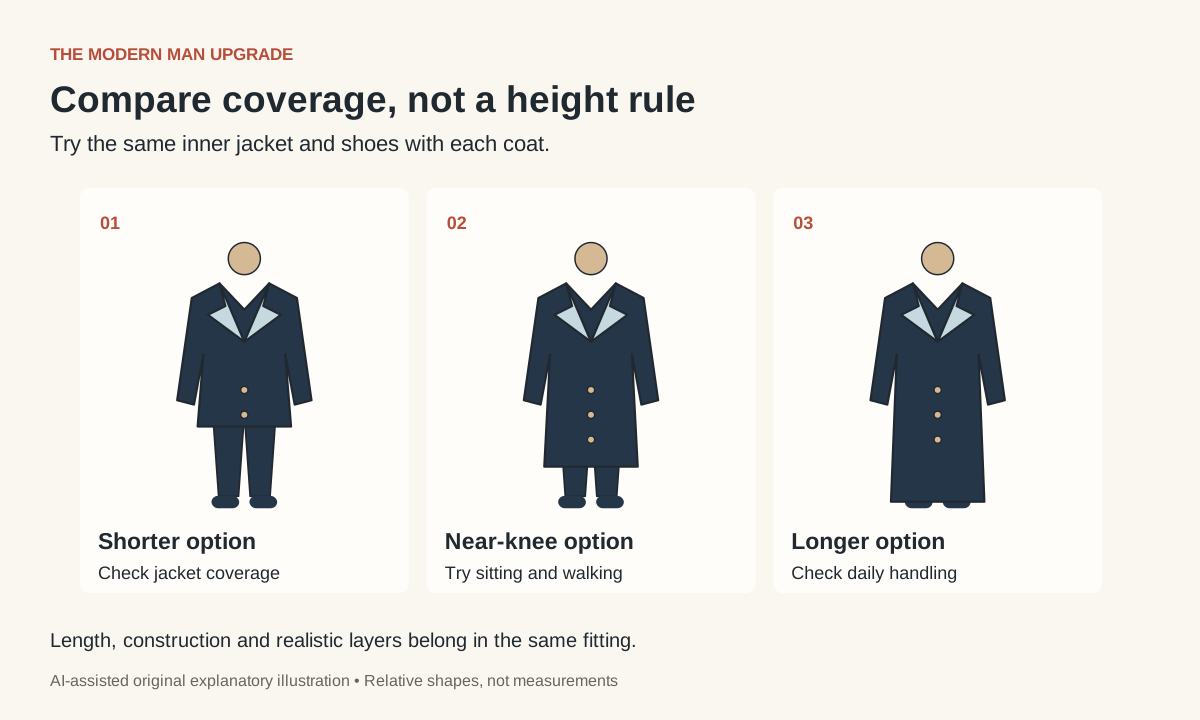
For a coat worn over tailoring, inspect whether the jacket below is covered in the way you want from the front and back. Then walk and sit. A standing hem measurement alone misses how the layers move. Keep the same shoes and inner jacket on while comparing lengths.
A longer coat may offer the coverage you want but be less convenient on a crowded seat. A shorter option may feel easier to handle while exposing more of the outfit. These are practical tradeoffs, not rules tied to your height. Photograph the alternatives from a similar distance if the changing-room mirror makes comparison difficult.
Test two complete outfits before buying
Try one work outfit and one casual outfit that already exist in your wardrobe. For example, compare a charcoal coat over navy tailoring and over a light knit with dark jeans. The point is to check the contrast, collar area and proportions, not to buy every item in an example.
With a double-breasted design, check how the front behaves both fastened and open if you will wear it that way. Inspect the lining, fastening and pocket access. Read the care label and consider whether the cleaning and storage routine fits your space and budget.
The suit buying guide covers the jacket underneath; the scarf guide helps assess the remaining room around the collar. Each piece should solve its own part of the outfit.
Overcoat questions
Should I automatically buy one size larger?
No. Use the maker’s chart and try realistic layers. Some designs already include layering room, and changing size can change more than chest width.
Must the coat end at my knee?
No. Compare coverage, movement and appearance on the actual garment. The illustrations show choices, not compulsory proportions.
Can one coat work with suits and jeans?
It can if its shape, fit and practical limitations suit both combinations. Test both before deciding it fills that role.
Use the free Top 3 filter to decide whether outerwear addresses a repeated need or whether a smaller fit or care change deserves attention first.