Pack a suit by choosing a method that fits the actual garment, bag and trip. Keep folds gentle, protect the suit from dirty or heavy items, and allow time to unpack on arrival. No packing method can promise a crease-free result for every fabric and journey.
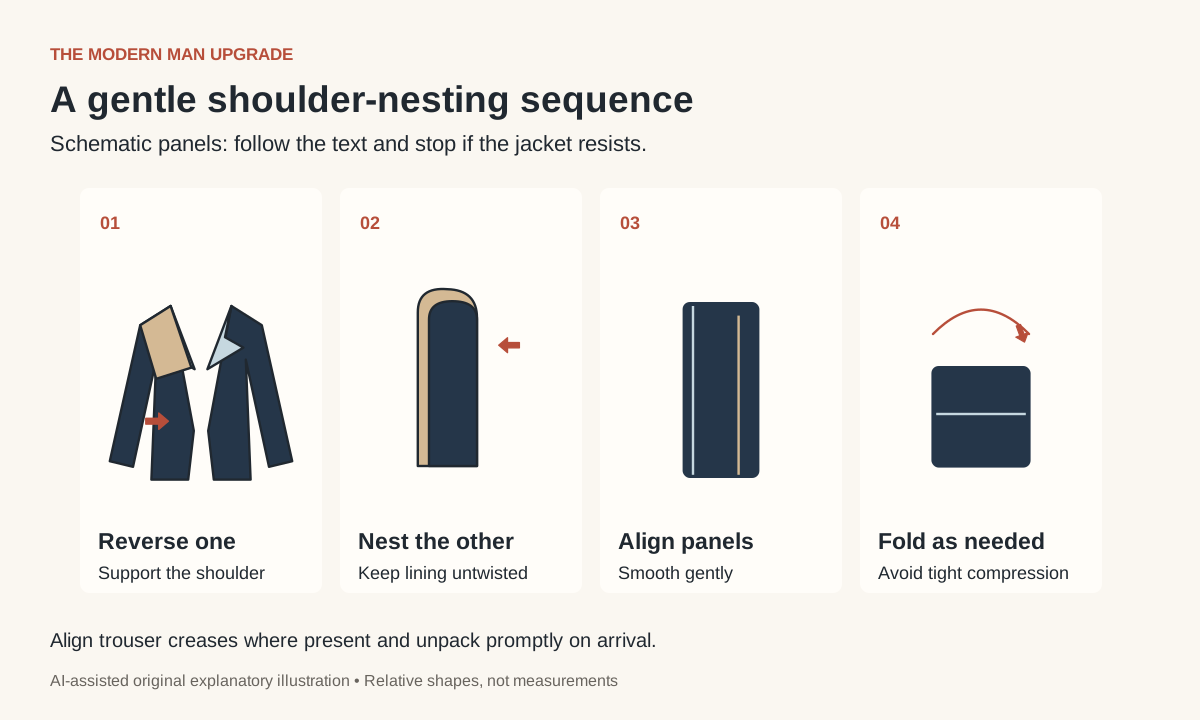
Check baggage rules for your carrier and ticket, then compare a suitable garment bag with folding into your case. For a jacket that tolerates it, gently reverse one shoulder, nest the other inside, align the panels and make a broad fold to fit. Pack trousers along their existing crease where applicable, avoid hard compression, and unpack early enough to assess the result.
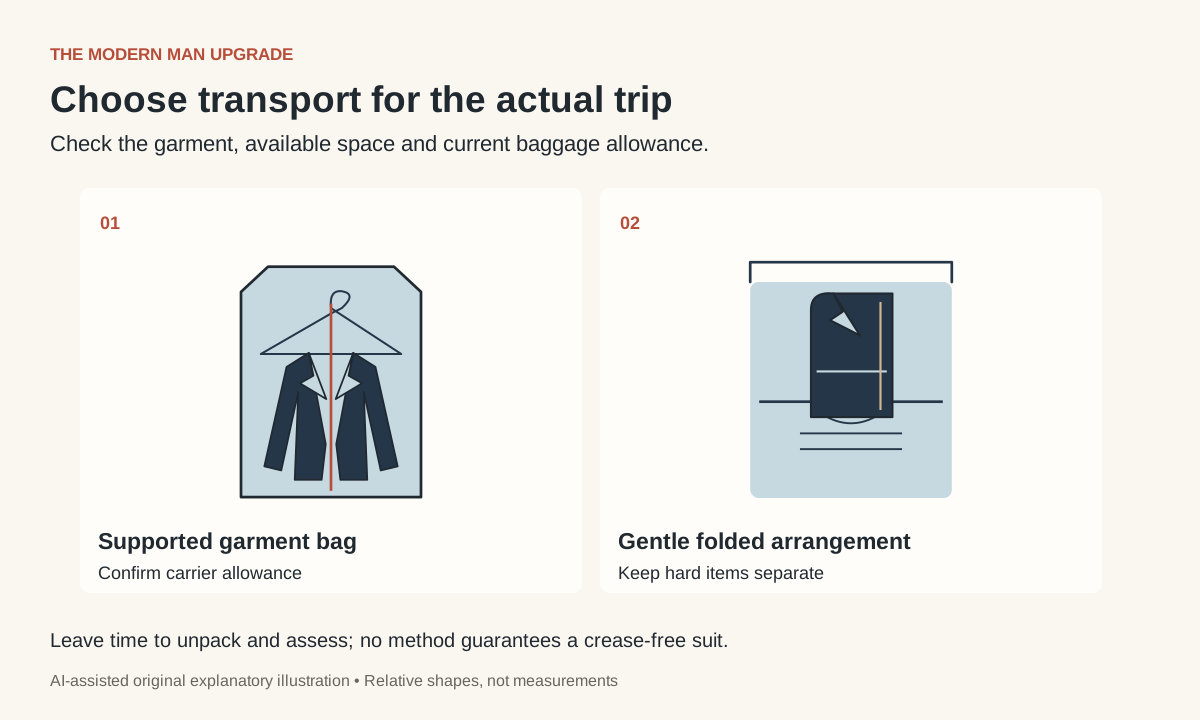
Plan the bag and the arrival window
Start with the event, journey and time available before wearing the suit. Decide whether it needs to stay accessible and whether suitable pressing is available at the destination. A same-day meeting and a trip with an evening to unpack present different margins for recovery.
Check baggage dimensions, allowance and garment-bag treatment with your carrier for the actual ticket. Do not assume a flight has a closet or that a suit bag is automatically an extra free item. Rules can differ, so verify them directly rather than relying on a general packing article.
List the complete outfit: jacket, trousers, shirt, footwear, socks and necessary accessories. The light-packing guide helps keep the rest of the bag practical. A carefully folded suit is not useful if its required shirt or shoes were left behind.
Choose hanging transport or a folded arrangement
A suitable garment bag can keep a jacket on a supportive hanger and reduce the folding needed. Check the bag’s actual support, closures and space; squeezing a long suit bag into a tiny compartment changes the result. Protect it during the rest of the journey as well as the flight or train ride.
A suitcase method is useful when the suit must share ordinary luggage. Test the available area before packing everything else. The jacket should fit without a hard forced crease or heavy objects pressed into its structure. A small compression cube is not automatically suitable just because the jacket can be made to fit inside.
Read any maker advice for unusual construction, delicate fabric or special finishing. If you are uncertain about reversing a shoulder, ask a tailor or use an appropriate alternative. Do not force a stiff or fragile section to behave like a soft unstructured jacket.
Try a gentle shoulder-nesting method
Victorinox’s suit-packing demonstration shows the inside-out shoulder fold. Its useful mechanics are summarized here; the amount of folding still depends on your jacket and bag.
- Work on a clean flat surface with the jacket arranged smoothly.
- Gently reverse one shoulder from inside the jacket, keeping the construction supported.
- Nest the other shoulder into the reversed shoulder so the jacket folds lengthwise.
- Align sleeves, panels and lapels without pulling the fabric out of shape.
- Make a broad horizontal fold only as needed for the available space.
Practice before travel day. If the shoulder resists or the lining becomes twisted, stop, return the jacket to its normal position and reassess. A demonstration is easier to follow when you are not already standing over a nearly closed case.
Pack trousers and protect the rest of the outfit
Where the trousers have an existing pressed crease, align it rather than creating a competing fold down another part of the leg. Smooth the garment gently and make only the broad folds needed for the bag. A pair designed without a crease should not acquire one solely to copy an illustration.
Place the suit where it will not be crushed by shoes, hard chargers or heavy toiletries. Separate potentially dirty items and protect accessories from snagging fabric. Close the case gently and check whether the packed arrangement shifts; straps should secure the load without digging a tight line across the jacket.
For example, pack shoes separately, keep hard objects away from the chest and shoulder area, and leave the suit accessible for early unpacking. This is an editorial packing check rather than a guarantee about every suitcase layout. Use the space your actual luggage provides.
The suit guide helps evaluate the garment itself. Travel damage, ordinary fit problems and a suit that is unsuitable for the event are different issues; careful packing cannot correct all three.
Unpack first, then assess wrinkles
Remove the suit when practical after arrival, return the jacket to a suitable hanger and arrange the trousers appropriately. Give the garment space to settle. Inspect the collar, lapels, sleeves and trouser crease in good light before deciding what needs attention.
Light wrinkles and a distorted structured area do not necessarily need the same response. Follow the maker’s care instructions for pressing or steaming; seek a suitable cleaner when structure or fabric makes the decision uncertain. Do not experiment with a hot iron on the visible lapel shortly before an event.
If you use a compatible garment steamer, follow the steamer routine and the actual machine manual. A steamy bathroom is not a reliable promise that a packed jacket will recover, and adding moisture is not a substitute for assessing the garment.
Use the return journey as a care check
Keep worn or soiled items separated and inspect the suit again at home. Decide whether it needs cleaning, a small repair or simply proper storage according to its condition. Record which bag arrangement worked so the next trip does not require inventing the method again.
If packing a suit is a frequent source of trouble, first compare bag space, compression and preparation time. Buying another suit is not necessarily the answer to a packing problem. An appropriate pressing service or better transport arrangement may solve the repeated issue more directly.
Suit-packing questions
Can a suit travel in a carry-on?
Often a suitable arrangement is possible, but fit and allowance depend on the bag, garment and carrier. Test the arrangement and check current baggage rules for your journey.
Should I roll the jacket tightly?
A tight roll can force pressure into the structure. Use an appropriate gentle method and respect the garment maker’s advice instead of treating it like a soft tee.
Will a garment bag eliminate every wrinkle?
No. Fabric, handling and compression still matter. Plan time to unpack and assess the result.
Use the free Top 3 filter to prioritize a practical travel preparation step alongside the other tasks for your event.